Index
Classes with this recipe
Index
The smell tells you before the timer does. Around minute eight the kitchen at Piazza Margana 22 goes from nothing to roasted hazelnut, and that is when people start opening the oven door to look. Two more minutes. The skins have to split and the kernel underneath has to be pale gold, and if you pull them at the smell the finished gelato tastes of raw nut.
This hazelnut gelato recipe is the one from our gelato workshop: whole hazelnuts you toast and grind yourself, a base of whole milk and cream sweetened with sugar and a spoon of honey, no eggs, no machine. The freezer does the freezing and a whisk does the rest, once every 30 minutes for 4 hours. It shares a freezer with our pistachio version, not a method: pistachio is blanched and ground raw, hazelnut is roasted, and the roast is most of the flavor. So this one earns its time in the oven.
Hazelnut gelato recipe for four, counted per person
Four cups come out of 120 g of shelled hazelnuts, 240 g of whole milk, 120 g of fresh cream, 80 g of sugar, 40 g of honey and a pinch of fine salt. Per person that is 30 g of hazelnuts, 60 g of milk, 30 g of cream, 20 g of sugar and 10 g of honey. Of the hazelnuts, 100 g go into the paste and 20 g get chopped for the top.
Buy the hazelnuts raw and shelled, skins on. The oven does the roasting and a cloth does the skinning. Pre-roasted nuts from the snack aisle are often months old, and old hazelnut oil tastes of cardboard. If a shop near you has Piedmont hazelnuts, use them: there are only 120 g in the recipe and nothing else is doing the flavor.
The cream is fresh liquid cream with at least 35% fat. Not a whipping product with stabilizers. The milk is whole.
The honey is a mild one, acacia if you can get it, a honey you cannot taste over the nuts. Chestnut would win that argument.
Ten minutes at 180 °C, and the color that says stop
Single layer on a tray, 180 °C, 10 minutes, a shake at the halfway mark so the edge and the middle trade places. That is the whole procedure, and it still goes wrong more than any other step, because people judge the nut by its skin.
Cut one in half. The outside of a hazelnut is skin, and skin darkens long before the kernel does. What you want is the skins cracked and lifting and a kernel that is pale gold at the center. Not brown. A brown kernel has crossed into bitter, and more sugar does not balance that; it just becomes bitter and sweet. Under-toasted is the milder fault: pale paste, and a gelato that tastes mostly of milk.
We run the oven at 180 °C rather than hotter because a class is a room full of distractions, and 180 °C leaves some margin before the kernels go over. Then straight onto a clean cloth, because on the hot tray they keep cooking, and the distance between right and brown is about a minute.
Skins off while they are warm, then 100 g of nuts becomes paste
Fold the cloth over and rub hard for a minute, while the nuts are warm. Cold, they cling. A few stubborn flecks do no harm.
The skin is where the tannin is. Leave it on and the paste goes brown-gray and the gelato finishes with a dry edge most people read as burnt. The Tonda Gentile grown in Piedmont, sold as Nocciola Piemonte IGP, is prized partly because its skin comes away cleanly in the oven. Other varieties hold on harder: rub longer.
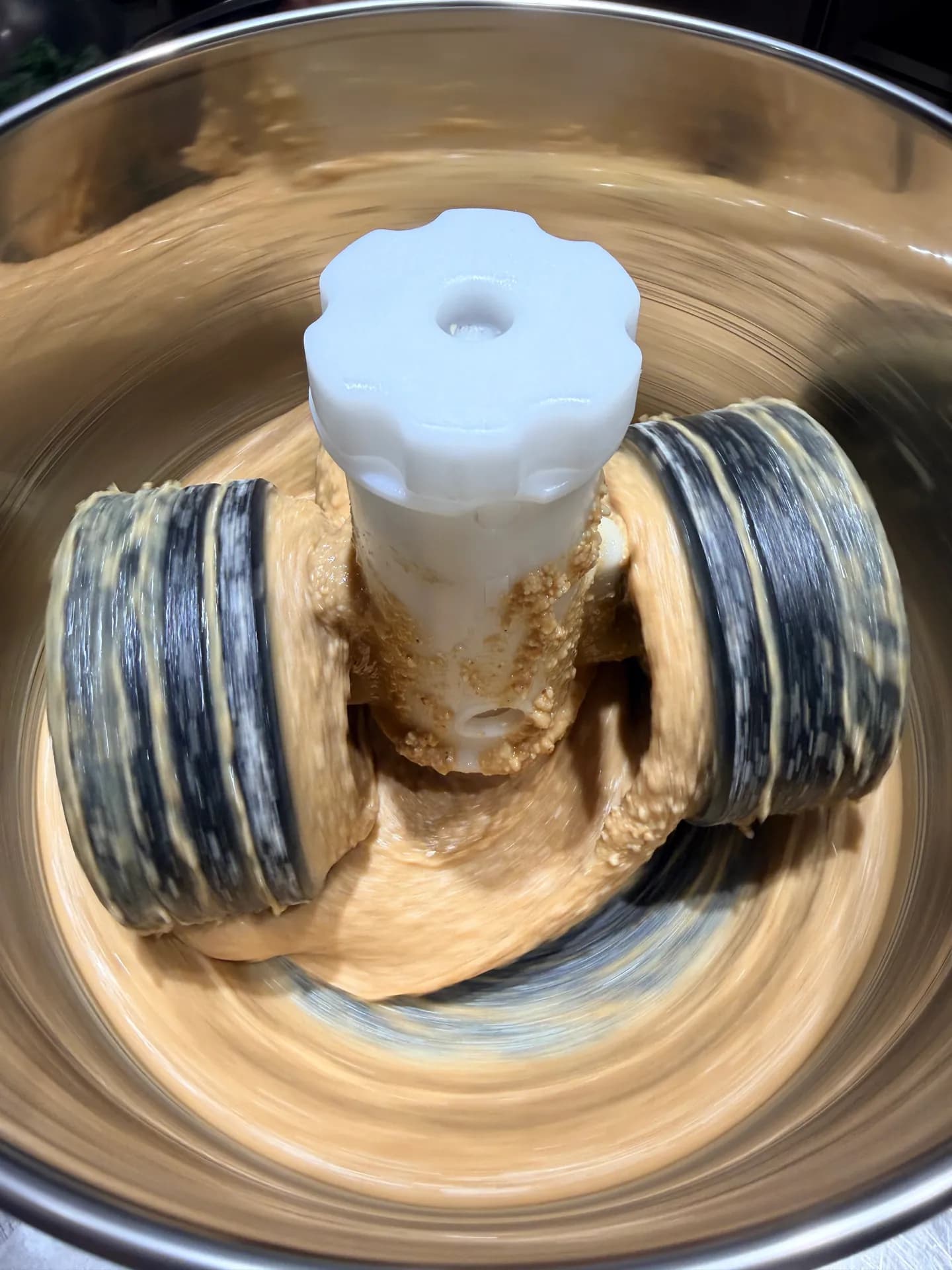
Set 20 g aside for the top and put the other 100 g in the blender, still warm. Pulses of 20 seconds, scrape the sides, pulse again, 5 to 8 minutes in total. Three stages: a powder, then damp sand that packs against the blades, then the oil lets go and the whole thing turns glossy and starts to flow. Stop when it slides off a spoon. Warm nuts give up their oil faster.
Somebody always asks why we do not simply chop the nuts and stir them in. Because chopped hazelnut in gelato is a texture, not a flavor. The flavor lives in the oil, and in a chopped piece the oil stays inside the piece: you taste milk, then crunch, then nut. Ground to a paste, the oil is spread through every gram of the mix and the milk tastes of hazelnut from the first spoon. The 20 g on top are for crunch, and only that.
If you buy the paste instead, read the label: one ingredient, hazelnuts, sometimes called hazelnut butter in the UK and the US, and 90 g stands in for the 100 g of nuts. Hazelnut spread is sugar, palm oil and cocoa with the nuts last, and gelato made with it tastes of the jar.
The sugar and honey balance that keeps it scoopable without a machine
A home freezer runs at about -18 °C, and a base of milk, cream and an ordinary amount of sugar sets into a brick at that temperature. A gelateria cabinet is warmer. We cannot change your freezer, so we change the tray.
Sugar lowers the freezing point, and honey lowers it more per gram than sugar does. That is why the sweetening is split: 80 g of sugar for taste and body, 40 g of honey for softness. Honey is mostly glucose and fructose, smaller molecules than table sugar, and smaller molecules keep more of the water unfrozen at -18 °C. Professional recipes use glucose syrup or dextrose for this, at the same weight; honey is what most kitchens have. All sugar and no honey, and after a night in the freezer you need a knife.
The cream is the other half of the softness. Fat does not turn into ice; it coats the crystals that form and keeps them apart, so the scoop bends instead of shattering. 240 g of milk to 120 g of cream is where the base still tastes of nut and holds a scoop.
No eggs, either. A custard base makes a fine gelato, but yolk has a flavor of its own and it sits on top of the roast. Without it the base only needs to reach 70 °C, enough to dissolve the sugar and honey.
How the hazelnut gelato recipe runs, from the pan to the whisk
Milk, sugar and honey first. 240 g of whole milk in a small pan with the 80 g of sugar and the 40 g of honey, low heat, stirring, about 5 minutes, until a thermometer reads 70 °C. Without one, pull it when the milk steams and the first tiny bubbles show at the rim.
Cream, paste and salt go in off the heat. 120 g of cream, the hazelnut paste and a pinch of salt. Stick blender, one full minute, head kept under the surface. The mix goes from streaky to an even beige. A ring of oil floating up means the milk proteins have not caught the nut oil yet: 30 seconds more. A head that breaks the surface whips air in, and a foamy base freezes into something closer to semifreddo.
Cold before the freezer. Pan into a bigger bowl of water and ice, a stir now and then, 30 minutes, until a finger in the base feels cold; the fridge gets there too, in 3 to 4 hours. The freezer works from the walls inward, and a warm base takes so long to reach zero that the first crystals grow long, and long crystals survive every whisk round that follows.
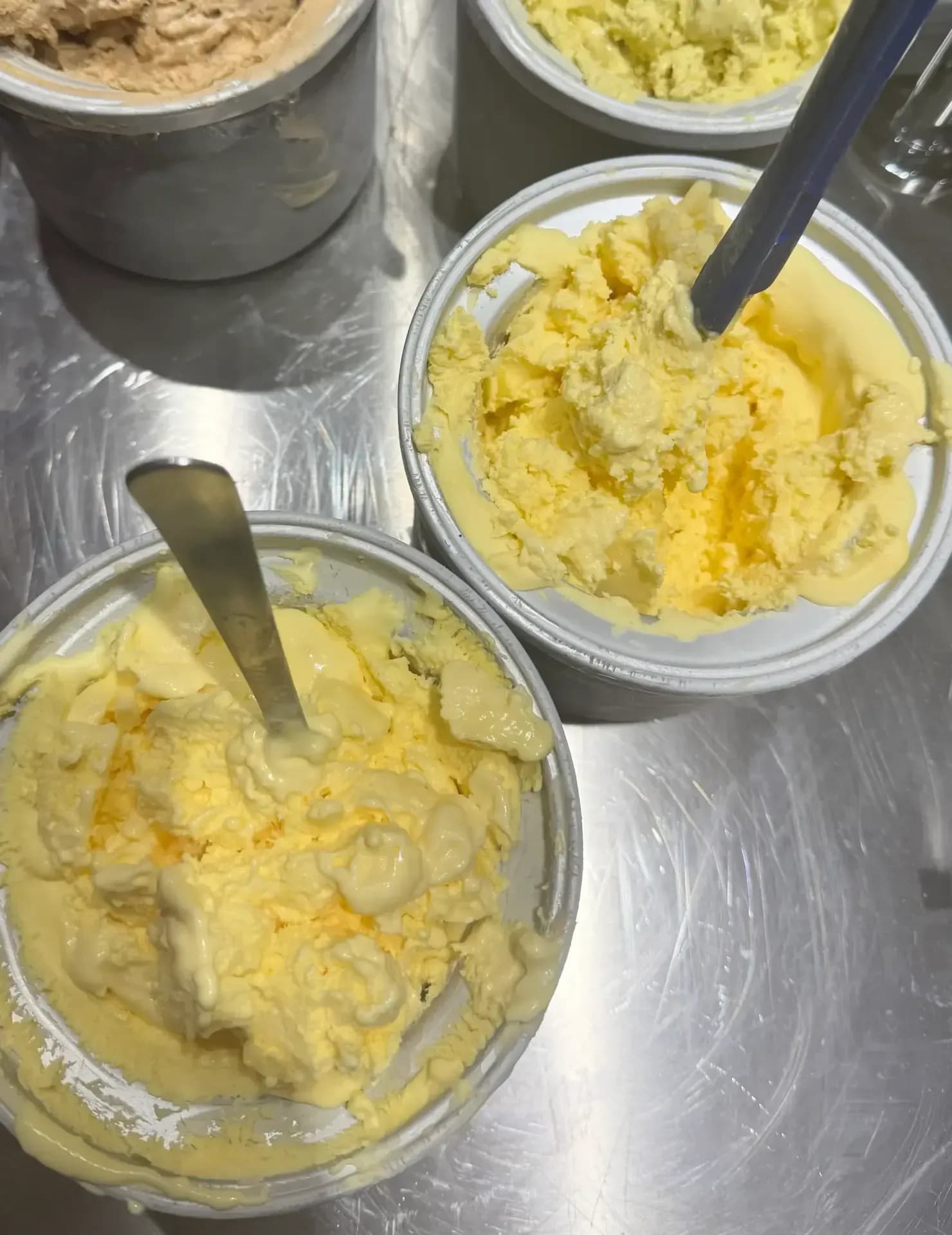
Then the freezer and the timer. A shallow steel container, the base no more than 2 to 3 cm deep, covered. From here the job is keeping the ice crystals too small to feel. A machine scrapes a frozen bowl nonstop; you do it by hand every 30 minutes: out, a hard whisk that drags the frozen rim into the soft middle, back in. Eight rounds over 4 hours. At 2 hours it looks like soft-serve; at the last round it keeps the marks of the whisk. Ten minutes on the counter, then scoop, with the 20 g of chopped hazelnuts on top.
The mistakes we see in class
These reach us by email the week after class, roughly in this order.
- Toasting by the clock. Ten minutes at 180 °C is our oven; a fan oven runs hotter, an old one cold. Look at minute eight and cut a nut before you trust the timer.
- Doubling the recipe in the same tray. Twice the base in one container sits 5 or 6 cm deep, and the middle is still liquid when the rim is rock. Two trays.
- Fixing the sweetness at the pan. The warm base should taste a shade too sweet, because cold mutes sugar. It is also not the place to add more: the 80 g and the 40 g decide how soft it freezes.
- The round that got forgotten. Forty-five minutes of conversation and the tray is a slab with a slush center. Whisking a slab gives you shards of ice in cream. Soften it 10 minutes, blitz it smooth with the stick blender, go back to the rounds. Gelato, just not as fine.
Serving it, keeping it, and the pistachio next to it
A cup shows the texture better than a cone, and it is how we serve it in class: two scoops, the chopped hazelnuts, nothing else. Rome puts hazelnut and pistachio in the same cup out of habit, and if you make the pistachio gelato as well, the two bases can do their freezer rounds side by side.
It keeps a week in the freezer in a sealed container and gets harder every day, because the freezer keeps pulling water into crystals. From the second day on, give it 15 minutes out and a turn with a spoon before scooping. What has melted does not go back in.
One variant worth making: hold back a spoonful of the paste and swirl it through at the last whisk round, for streaks of pure hazelnut in the scoop.
Where to learn hazelnut gelato in Rome
In our kitchen at Piazza Margana 22, in the historic center. The gelato making class lasts about 90 minutes and is built around the base: you prepare it from scratch with the chef, balance the ingredients and work on the texture, with no machine, so the method comes home with you. What a written recipe cannot show you is the color of a kernel cut in half and the second the paste lets go of its oil. The class opens with a welcome of Italian wines, espresso and traditional cookies, and pistachio and hazelnut are both on its sample menu. The same workshop also runs as a private session.
If you would rather make it after a pizza, the pizza and gelato class runs about two and a half hours: you make the dough from scratch, bake your own pizza and finish with gelato. Everything else we run is on the cooking classes page.
Recipe details
Hazelnut gelato the way we make it in the gelato workshop at Piazza Margana 22: whole hazelnuts toasted in the oven and ground into a paste, a milk and cream base sweetened with sugar and a spoon of honey, no eggs and no ice cream machine. The mix goes into the freezer in a shallow steel tray and gets stirred every 30 minutes for 4 hours. One rule: the flavour comes from nuts you toasted yourself, never from a jar of spread.
Preparation
Toast 120 g of hazelnuts at 180 °C
Spread 120 g of shelled hazelnuts in a single layer on a tray and put them in the oven at 180 °C for 10 minutes, shaking the tray once at the halfway mark so they colour evenly. They are done when the thin skins have cracked and lifted, the kitchen smells of hazelnut and a kernel cut in half is pale gold in the centre. Brown means bitter, and bitter cannot be fixed later with sugar. Tip them onto a clean cloth straight away.
Skin them and blend 100 g into a paste
Fold the cloth over the warm hazelnuts and rub them hard for a minute: most of the skins come away, and a few stubborn flecks do no harm. Set 20 g aside and chop them for the finish. Put the other 100 g, still warm, in a blender and work in pulses of 20 seconds, scraping the sides between pulses, for 5 to 8 minutes in total. They go from powder to damp sand to a glossy paste that flows slowly off a spoon. Stop there.
Heat milk, sugar and honey to 70 °C
Pour 240 g of whole milk into a small pan with 80 g of sugar and 40 g of honey. Low heat, stirring, for about 5 minutes: the sugar dissolves, steam rises, and a thermometer reads 70 °C. No bubbles at the edge. Boiling is not a disaster, but it changes the taste of the milk and you lose water you had measured. Take the pan off the heat as soon as it reaches temperature.
Emulsify with cream and hazelnut paste
Off the heat, add 120 g of fresh cream, the hazelnut paste and a pinch of salt. Blend with a stick blender for a full minute, keeping the head under the surface so you do not whip air in. The mix turns from streaky to an even beige and no ring of oil floats to the top. If it does, blend another 30 seconds: the paste has released oil that the milk proteins still need to grab.
Chill the base in an iced bath
Set the pan in a larger bowl with water and ice and stir now and then for 30 minutes, until the base is cold on the finger. A fridge works too but takes 3 to 4 hours. This step decides the texture: a warm base freezes slowly from the outside in and grows long crystals, a cold one freezes fast and fine. Skip it and the stirring later will only chase a problem you created here.
Freeze and stir every 30 minutes for 4 hours
Pour the cold base into a shallow steel container, 2 to 3 cm deep at most, cover it and put it in the freezer. Every 30 minutes take it out and whisk, dragging the frozen rim into the soft centre until it is even, then back in. Eight rounds. After 2 hours it looks like soft-serve; by the end it is firm enough to hold the whisk marks. Set a timer: the round you forget is the one that turns the tray into a block.
Rest, scoop and top with hazelnuts
Take the gelato out 10 minutes before serving so it softens enough to scoop, then serve it in cups or on a cone with the 20 g of chopped toasted hazelnuts over the top. It keeps in the freezer for a week in a sealed container, though it gets harder every day: give it 15 minutes out and a stir with a spoon before scooping. Do not refreeze what has melted.
What the whisk is doing in there, and the round everyone forgets
Gelato is water, fat, sugar and air, and the whole craft is keeping the water in crystals too small to feel on the tongue. A machine does it by scraping the walls of a frozen bowl continuously. In a freezer the mix freezes from the walls inward, and the crystals that form there keep growing as long as nobody breaks them. Every whisk round shatters them and mixes the frozen rim back into the soft centre, so the next crystals start small again. That is the entire method. The sugar and the honey help because they lower the freezing point, and the fat in the cream coats the crystals and keeps the scoop soft.
The mistake we see most in class is not a technique problem. Somebody gets talking, forty-five minutes pass, and the tray has set into a slab with a slushy middle. Whisking a slab does not bring it back: you get shards of ice in a cream. If it happens, let it soften 10 minutes, blitz it with the stick blender until smooth and go back to the 30-minute rounds. It will not be as fine, but it will be gelato.
The container decides how much work the whisk has to do. A deep plastic tub freezes slowly and only at the edge, so at round three the centre is still liquid while the rim is rock. Steel, wide and shallow, 2 to 3 cm of mix, freezes evenly and fast. Just as often the base goes in warm because the class is short on time: it freezes slowly, grows long crystals and stays grainy no matter what you do after. The iced bath is 30 minutes; that is the cheapest half hour in the recipe.
One more thing happens earlier, at the blender. If the head comes up through the surface while you emulsify, it whips air in, and a foamy base freezes into something between gelato and a semifreddo. Keep it under, and the mix should look like thick milk, not like a mousse.
Hazelnuts, hazelnut paste and what to buy abroad
The hazelnut Italians mean when they say gelato alla nocciola is the Tonda Gentile Trilobata, grown in Piedmont and protected as Nocciola Piemonte IGP: a roundish kernel of 17 to 21 mm whose skin comes away cleanly in the oven and whose flavour stays in the mouth long after the sweetness is gone. It costs more than other hazelnuts and it is worth it here, because there are only 120 g in the recipe and nothing else is doing the work. If you cannot find it, any fresh, raw, shelled hazelnut will do: buy them raw and toast them yourself, since pre-roasted nuts are often older and already tired.
Hazelnut paste and hazelnut spread are two different products, and this is where most home attempts go wrong. The paste is 100% ground toasted hazelnuts, nothing else, the consistency of thick honey with a layer of oil on top after a while. The spread is sugar, palm oil, a little cocoa and some hazelnuts, and in a gelato it tastes of cocoa and fat. If you would rather buy the paste than make it, read the label: one ingredient. In the UK and the US it is sometimes sold as hazelnut butter, which is the same thing.
On the honey: it stands in for the glucose that Italian recipes use, in the same dose, and it does the same job of keeping the gelato soft in a home freezer. Choose a light one, acacia or wildflower. A chestnut honey will show up in the flavour. On the cream: it must be fresh liquid cream with at least 35% fat, not a whipping product with stabilisers, which changes how the base freezes.
Whole milk, not semi-skimmed. The fat is part of the recipe, and the difference is obvious in the scoop.
From the Langhe to a Roman cup: origin, gianduia and how it is served
Hazelnut gelato comes from the north, not from Rome. The Piedmont hills around Alba and Cuneo have grown hazelnuts for centuries, and it was Turin that turned them into gianduia, the hazelnut and chocolate paste that became a gelato flavour of its own. Nocciola on its own, without cocoa, is the purer version and the one that shows whether the toasting was done well: in a good one you taste the roast first, then the milk, and the sweetness stays behind both.
In Rome it is a classic pairing with pistachio in the same cup, the two flavours that gelaterias put next to each other because they sell together. A cup with a spoon shows the texture better than a cone, and it is how we serve it in class, with the chopped toasted hazelnuts over the top and nothing else. Whipped cream on top is a Roman habit and nobody will stop you.
This is one of the flavours we teach in the gelato workshop at Piazza Margana 22, a 90-minute class that spends most of its time on the base, because that is where the texture is decided, and it is the gelato that closes the pizza and gelato class and its gluten-free version, since there is no flour anywhere in it. The point of teaching it without a machine is that the method comes home with you: an oven, a pan, a steel tray and a timer.
Gelato is naturally gluten-free: in the gluten-free pizza and gelato class only the cone changes, for a gluten-free version.
Ingredients
120 g of shelled hazelnuts, 30 g per person, toasted: 100 g for the paste and 20 g chopped for the top
240 g of whole milk, 60 g per person
120 g of fresh cream, 30 g per person, at least 35% fat
80 g of sugar, 20 g per person
40 g of honey, 10 g per person, a mild one such as acacia
A pinch of fine salt
Water and ice for the cooling bath
Method
- 1
Toast first, because everything else waits on the nuts. 120 g of shelled hazelnuts on a tray at 180 °C for 10 minutes, turned once halfway. Take them out when the skins have split and the kernel underneath is pale gold, not brown. Rub them in a cloth while warm, set 20 g aside for the top and blend the other 100 g in pulses until they give up their oil and turn into a paste that slides off a spoon.
- 2
The base is milk, sugar and honey heated to 70 °C. 240 g of whole milk, 80 g of sugar and 40 g of honey in a small pan over low heat for about 5 minutes: it should steam, never bubble. Off the heat, add 120 g of cream, the hazelnut paste and a pinch of salt, then blend with a stick blender for a full minute so the fat is properly emulsified.
- 3
Cold before frozen. Set the pan in a bowl of iced water and stir now and then for 30 minutes, until the mix is cold to the finger. A warm base thrown into the freezer grows large crystals, and no amount of stirring gets rid of them later.
- 4
Then the part that replaces the machine. Pour the mix into a shallow steel container, freeze it and stir every 30 minutes with a whisk, dragging the frozen edges into the soft centre. Eight rounds over 4 hours. Around the fourth round it looks like soft-serve; by the last it holds the marks of the whisk. Ten minutes out of the freezer, scoop, and finish with the chopped hazelnuts.

Written by
Francesco Ieriti
Founder of Italian Cooking Classes in Rome and head chef, with more than 14 years in international hospitality. He writes the recipes on this blog the way they are taught in class at Piazza Margana 22: per person, mistakes included.