Index
Index
Trastevere means "across the Tiber", and for many visitors it's exactly the Rome they came looking for: cobbled lanes, ivy on ochre walls, a piazza that fills up every evening. Trastevere food, though, isn't a cuisine of its own. It's Roman cooking, served in a neighborhood that has kept its bakeries, its morning market and its trattorias, alongside plenty of places that live on passing crowds.
This guide helps you tell one from the other: what to order, what to eat on your feet, where the main piazza and the San Cosimato market are, when to go, how to spot a tourist trap without reading reviews, and how our guided food tour works.
What Trastevere food should you order at the table?
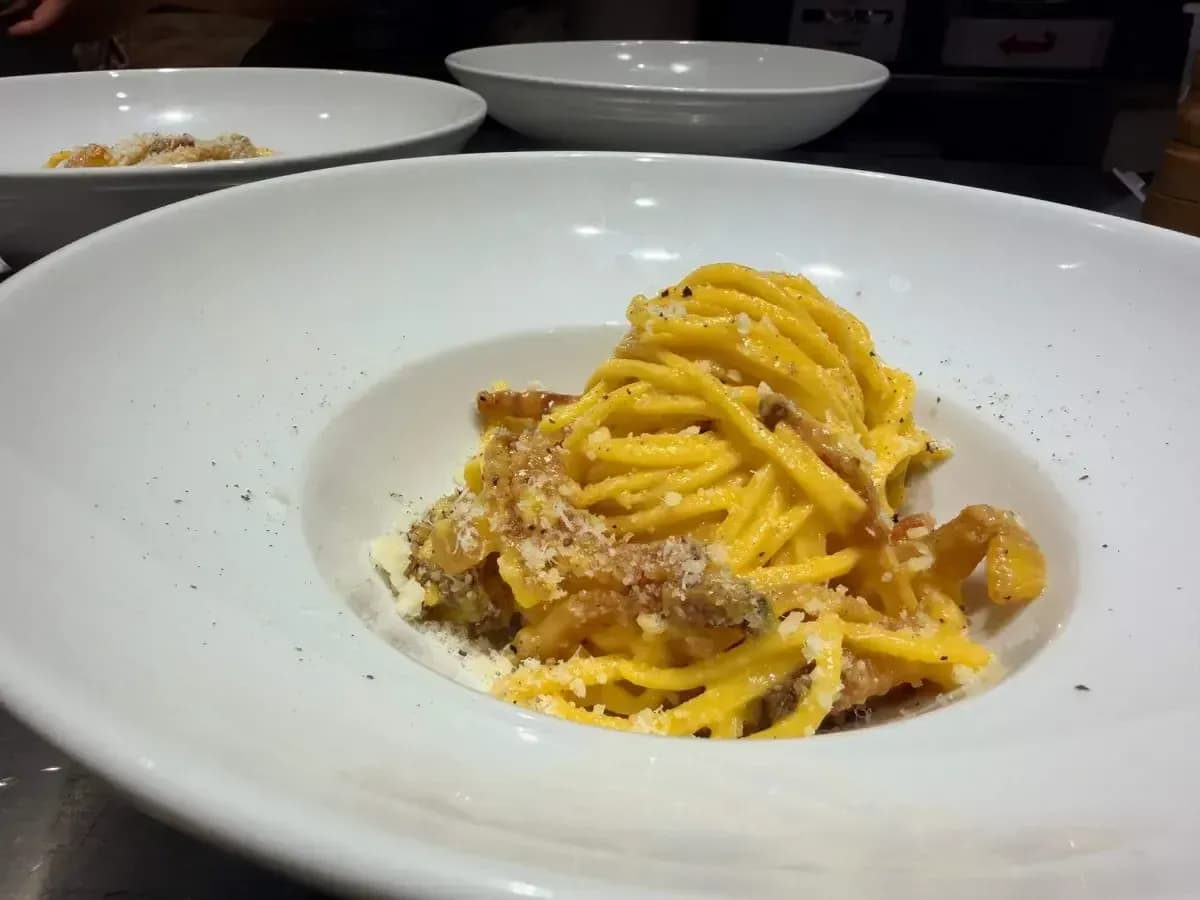
Start with the four Roman pastas, on their home ground. Cacio e pepe is pecorino, black pepper and pasta water whisked into a cream; gricia adds guanciale, cured pork cheek; amatriciana is a gricia with tomato, and carbonara a gricia with egg yolk. If the cacio e pepe is lumpy or the carbonara arrives with cream, you know all you need to know about the kitchen.
For a main course, Rome turns to the quinto quarto, the offal and humble cuts the city has cooked for centuries: tripe with tomato, mint and pecorino, or oxtail braised for hours as coda alla vaccinara. Lighter choices are saltimbocca, veal with sage and prosciutto, or abbacchio, young lamb, in spring.
Vegetables are a course of their own. Carciofi alla romana are braised with mint; carciofi alla giudia, fried whole until the leaves open like a flower, come from the Roman Jewish kitchen of the Ghetto, just across the river. In winter, order puntarelle, crisp chicory shoots dressed with anchovy, garlic and vinegar. For the rest of the city's classics, see our guide to what to eat in Rome.
What street food can you eat while walking around Trastevere?
- Supplì: rice cooked in tomato sauce, often with ragù, wrapped around a piece of mozzarella, breaded and fried. Break it in half: if the cheese stretches into a string, that's the supplì "al telefono". It should be hot and crisp, not soft from hours in a display case.
- Pizza al taglio: pizza baked in rectangular trays, cut to the size you ask for and sold by weight. Point, say how much, eat it standing up.
- Pizza tonda: the round Roman pizza is thin and crisp, an evening meal at a pizzeria, often after fritti such as battered salt cod or stuffed zucchini flowers.
- Maritozzo: a soft sweet bun split open and filled with whipped cream, the Roman breakfast with a cappuccino.
- Gelato at any hour and, in summer, grattachecca: hand-shaved ice with syrup and fruit, sold from kiosks along the river.
Almost all of it is made with wheat, which is hard going for coeliac guests; what we offer them in the kitchen is at the end of this guide.
Where are Piazza di Santa Maria in Trastevere and the San Cosimato market?
From the historic center, the classic way in is on foot over Ponte Sisto, which lands you in Piazza Trilussa, with its fountain and steps where the neighborhood gathers at dusk. From there the lanes lead to Piazza di Santa Maria in Trastevere, the heart of the district: the basilica is one of the oldest churches in Rome, with gold mosaics on its façade, and the fountain in the middle, itself among the oldest in the city, is where everyone arranges to meet.
A few minutes south is Piazza di San Cosimato and its market, the neighborhood's everyday shopping: seasonal fruit and vegetables, meat and cheese. It's small and usually held in the morning, so check the days before you go. Our guide to Rome's food markets covers it alongside Campo de' Fiori, Testaccio and the others. If you'd like to shop a market with a chef, our market tour and cooking class starts at Campo de' Fiori, just across Ponte Sisto.
Viale di Trastevere, the wide avenue with the tram tracks, cuts the district in two. West of it are Santa Maria, San Cosimato and the busiest lanes; east of it, around the Basilica of Santa Cecilia, the streets are quieter.
When is the best time to eat in Trastevere?
Morning belongs to the people who live here: the market, a maritozzo and a coffee at the counter, empty streets. Lunch is for pizza al taglio or a proper Roman lunch in a trattoria, which starts around one. Late afternoon is the quietest time for a walk and a gelato.
Evening is when Trastevere fills up. Aperitivo starts early, but Romans rarely sit down to dinner before eight, and Friday and Saturday nights are the most crowded. If you want a table without a wait, go early; if you want the neighborhood the way Romans live it, go late.
The season changes the menu more than the hour. Artichokes are at their best from late winter into spring, puntarelle through the winter, zucchini flowers in late spring and summer. In the second half of July, the Festa de' Noantri, Trastevere's own festival, fills the streets with processions and events.
How do you avoid tourist traps in Trastevere?
No names, just the signs we look for ourselves.
- Someone at the door inviting you in. A kitchen that cooks well doesn't need to hand out menus in the street.
- A laminated menu in six languages with a photo of every dish. It's written for people who pass by once.
- The same menu all year. Artichokes in August mean the kitchen isn't following the season.
- Dishes that aren't Roman sold as Roman. Carbonara "with cream" or spaghetti bolognese next to the cacio e pepe says the menu is chasing expectations, not tradition.
- A dining room full at seven and empty at nine. Romans eat late; a place that fills up after half past eight is cooking for the neighborhood.
- Gelato piled into bright mounds. Look for muted colors and covered steel tubs. Pistachio should be pale olive, close to khaki, not emerald: our pistachio gelato recipe explains why.
The best sign of all is a short, handwritten menu that changes with the market. And step a street or two away from the main piazzas: the best view rarely comes with the best cooking.
Is a guided Trastevere food tour worth it?
It is if you want to taste a lot in a short time without judging every doorway yourself. Our Trastevere food tour is a two-and-a-half-hour walk through the neighborhood with a local food guide. Along the way you taste Roman street food and local specialties, all tastings and Italian wines are included, and at each stop the guide explains what you're eating and the story behind it.
In practice:
- It's a shared tour: you walk with other travelers, and there is no private version.
- Like all our shared experiences, it's in English.
- It meets in Piazza Mastai, in Trastevere, not at our kitchen; the dates still open are on the tour page.
- Tell us about allergies or dietary needs when you book, not on the day.
It works best early in a trip, before you know whom to trust.
Would you rather cook these Roman dishes yourself?
Then take them home in your hands. Our Roman pasta class is two and a half hours on carbonara, cacio e pepe and amatriciana, with fresh egg pasta made by hand to go with them, wine and Italian espresso included. The rules, said plainly:
- Pork: every class we run can be made without pork except this one. Its carbonara and amatriciana are built on guanciale, and an amatriciana without guanciale is just pasta al pomodoro, so the Roman pasta class is never offered pork-free.
- Gluten: a class cooked with gluten is never gluten-free, not even for one portion, not even on request. Coeliac guests book one of our two dedicated gluten-free classes, gluten-free pasta with tiramisù or gluten-free pizza with gelato, which are private. In our group formats, from families and schools to team building, the whole group can choose one of those two gluten-free menus; for the largest groups it isn't guaranteed and is arranged with our staff.
- Language: shared classes are taught in English; private classes can also be taught in Italian or Spanish.
What should you eat on your first visit to Trastevere?
Walk over Ponte Sisto in the late afternoon, eat a supplì while it's still hot, sit down after eight for a Roman pasta, cacio e pepe if you want to test the kitchen, and finish with a gelato the color of the fruit it's made from. With a morning to spare, start at San Cosimato: what's in season there tells you what to order at dinner.
And if you'd rather someone else chose the stops, book the Trastevere food tour and spend the walk tasting instead of reading menus.

Written by
Francesco Ieriti
Founder of Italian Cooking Classes in Rome and head chef, with more than 14 years in international hospitality. He writes the recipes on this blog the way they are taught in class at Piazza Margana 22: per person, mistakes included.