Index
Index
Ask what to eat in Rome and the list comes back in seconds: carbonara, supplì, pizza, gelato. The list is right. What it leaves out is when each dish belongs on the table, and how to tell a good plate from a tired copy.
We teach several of these dishes in our kitchen at Piazza Margana 22, so this guide is written from the stove: what each dish is, when Romans eat it, and the signs of one made properly. Where we cook it in class, we link the recipe and the class. No restaurant names here: places change hands, but a good carbonara looks the same everywhere.
Carbonara, cacio e pepe, amatriciana and gricia: one family
Rome's four classic pasta sauces are one family. They share pecorino romano, a sharp, salty sheep's cheese, and three of them share guanciale, cured pork jowl, which is neither pancetta nor bacon.
- Gricia: guanciale, pecorino and black pepper. The white ancestor of amatriciana.
- Amatriciana: gricia plus tomato. It comes from Amatrice, a mountain town in the province of Rieti, whose own recipe excludes onion and garlic. Rome serves it on bucatini, Amatrice on spaghetti.
- Carbonara: guanciale and pecorino bound with egg, and plenty of black pepper.
- Cacio e pepe: no meat at all, just pecorino, black pepper and the starchy water the pasta cooked in, traditionally on tonnarelli, the square-cut Roman fresh pasta.
All four are a primo, eaten at lunch or dinner all year round.
How to tell a good carbonara, cacio e pepe or amatriciana
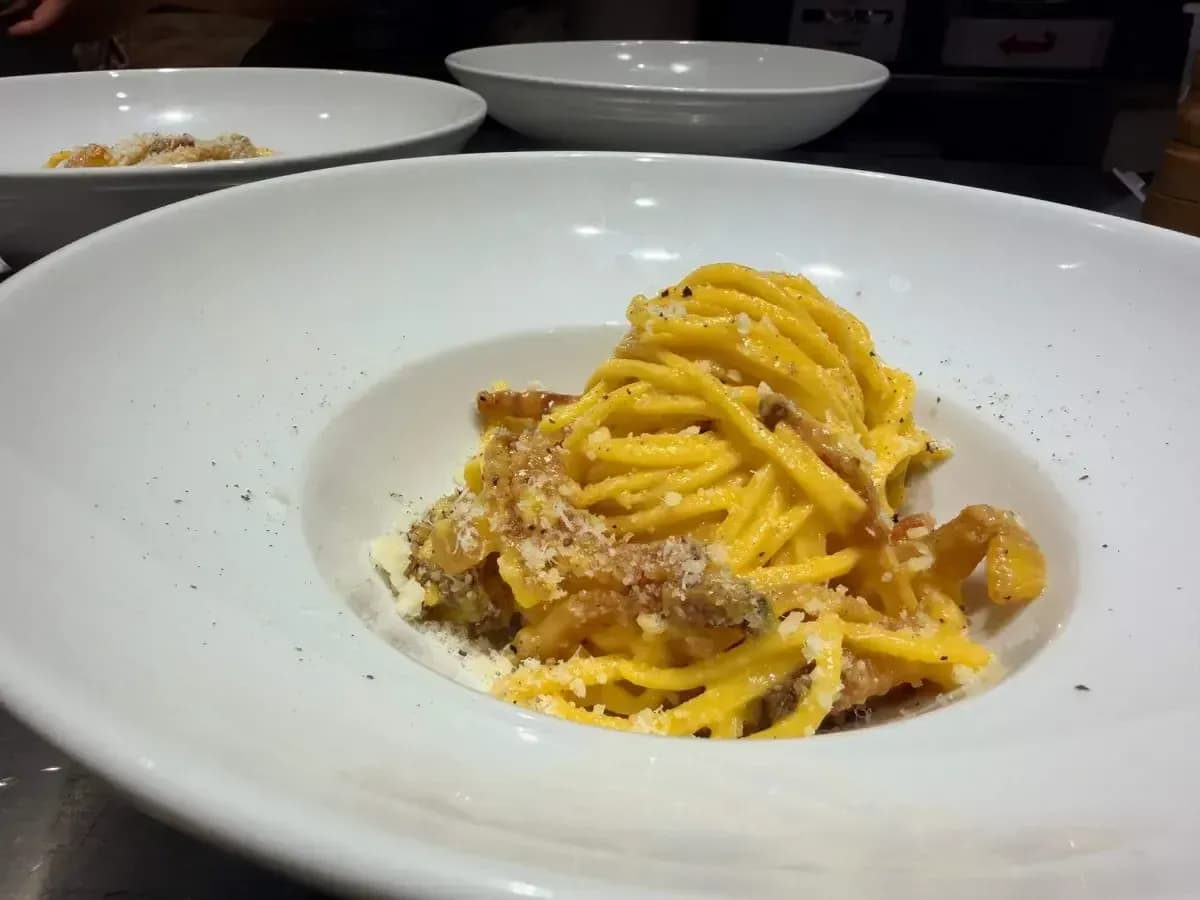
Carbonara should be glossy and deep yellow, coating every strand, with the guanciale crisp outside and soft inside. Threads of cooked egg mean the pan was still on the flame when the eggs went in. No cream, no garlic, no onion, no parmigiano. Ours uses one yolk per person plus one whole egg for the pan, and the carbonara recipe has the method.
Cacio e pepe hides nothing. You want a pale, smooth cream flecked with pepper and nothing pooled on the plate; strings of cheese mean the pecorino met too much heat. In our cacio e pepe the cheese goes in with the flame off, and there's no butter, oil or cream.
Amatriciana should cling to the pasta, with an orange sheen of guanciale fat at the rim. Many Roman kitchens add onion; ours leaves it out, as Amatrice does. Gricia follows the carbonara rules without the egg: creamy, never dry, never greasy.
We cook carbonara, cacio e pepe and amatriciana in the Roman pasta class, on fresh tonnarelli made by hand. That class is built on guanciale and is never offered without pork: an amatriciana without guanciale is just pasta al pomodoro. All our other classes can be made without pork.
Supplì and fiori di zucca: Rome's fritti
Fried food opens a Roman meal, at the counter or as a starter at the pizzeria.
Supplì is a rice croquette: rice cooked in tomato sauce, often with meat, shaped around a piece of mozzarella, breaded and fried. Break it open and the mozzarella stretches like an old telephone cord, hence the name supplì al telefono. A good one is hot right through and crisp without tasting of old oil. If the mozzarella won't stretch, it has gone cold.
Fiori di zucca are zucchini flowers filled with mozzarella and anchovy, dipped in batter and fried, from late spring through summer. The batter should be thin enough to show the shape of the flower, and nothing should drip when you pick one up.
We don't fry these in class: eat them straight from the oil. Roman street food is what our Trastevere food tour is built around, with a local guide, and our guide to what to eat in Trastevere covers that side of the river.
Carciofi alla giudia and alla romana: Rome's artichokes
From late winter into spring the Roman artichoke, the round, thornless carciofo romanesco, is on every menu, cooked two very different ways.
Carciofi alla giudia come from the cooking of Rome's Jewish community. The whole artichoke is trimmed and fried in olive oil, usually twice, until the leaves open like a flower. Outer leaves crisp like chips, a tender heart, golden brown rather than black, and never oily.
Carciofi alla romana are braised: stuffed with mentuccia, a wild mint, garlic and parsley, then cooked upside down in a covered pan with oil and water, and often served at room temperature, stem up. A good one gives way under the fork right down to the base.
Out of season, ask which artichoke you're getting. Our market tour and cooking class starts at Campo de' Fiori, where you choose what's in season with the chef; the city's other markets are in our guide to Rome's food markets.
Pizza romana and pizza al taglio
Rome has two pizzas, and they keep different hours.
Pizza romana is the evening one, at a pizzeria: a very thin base rolled out flat, a low rim and a crust that cracks under the knife. Romans call it scrocchiarella, crunchy. A good one stays crisp to the center and doesn't fold under its toppings.
Pizza al taglio is the daytime one: baked in rectangular trays, cut with scissors, sold by weight and eaten standing up. Bakeries sell its plainer cousins, pizza bianca with olive oil and salt, and pizza rossa with tomato. A good slice has an airy, open crumb and a bottom that sounds crisp when you tap it.
In our pizza and gelato class you stretch a round margherita by hand, without a rolling pin, so the rim puffs up in the oven; the pizza dough recipe explains why. Celiac guests book the private gluten-free pizza class instead.
Maritozzo: breakfast with whipped cream
The maritozzo is a soft, sweet bun split open and filled with a thick band of whipped cream. It's breakfast, eaten at the bar counter with a cappuccino. The name is usually traced to marito, husband, from the custom of a young man giving one to his future bride.
A good one has a light bun, never dry, and cream that tastes of cream, fresh and barely sweet. Cream that tastes of sugar, or stands up like frosting, is a reason to try another counter. It belongs to Rome's bars and pastry shops, not to our class menus.
Gelato artigianale: how to spot a good one
Gelato in Rome has no fixed hour, and it's usually eaten walking. The word artigianale on the sign is where the checking starts, not where it ends.
- Color. Real pistachio is pale olive, closer to khaki than to emerald; banana is grayish beige, not yellow.
- Display. Gelato kept level in its tubs, or under steel lids, is a better sign than mountains piled above the rim.
- Season. Fruit follows the calendar: strawberry in spring, fig in late summer.
- Taste. Smooth, melting evenly, the ingredient first and the sugar second.
We make pistachio and hazelnut in the ninety-minute gelato class, with no machine, and at the end of the pizza class. The pistachio gelato recipe explains that color.
Tiramisù and spritz, two imports from the north-east
Two things you'll order in Rome come from Italy's north-east.
Tiramisù is savoiardi dipped in coffee, layered with a cream of mascarpone, eggs and sugar and finished with bitter cocoa; the most accepted account places its birth in Treviso. A good one holds its shape on the plate, with biscuits soft but not dripping, no puddle of coffee underneath, and dry cocoa dusted at the last moment. Ours, with no cream and no alcohol, closes the pasta and tiramisù class, and the tiramisù recipe has the method.
Spritz is the aperitivo drink, the glass before dinner: prosecco, Aperol and a splash of soda over plenty of ice, half a slice of orange, something salty on the side. A good one comes in a wine glass packed with ice and isn't syrupy at the bottom, as it is when the Aperol goes in first. It opens our spritz and spaghetti class, and the spritz recipe gives the order: ice, prosecco, Aperol, soda.
What to eat in Rome if you only have one day?
Follow the Roman clock:
- Breakfast: a maritozzo and a cappuccino at the bar.
- Late morning: pizza bianca or a slice of pizza al taglio.
- Lunch: a Roman pasta, carbonara or cacio e pepe if you must choose.
- Afternoon: gelato, walking.
- Early evening: a spritz with something salty.
- Dinner: supplì and fiori di zucca, then a thin pizza romana; in spring, artichokes alla giudia or alla romana.
- Dessert: tiramisù, if there's room.
Each dish has its hour or its season; eating it then is half of eating it well.
Can you eat Roman food gluten-free, pork-free or vegetarian?
Partly, and it helps to know where the lines are.
Gluten. Pasta, pizza, supplì, maritozzo and tiramisù all contain gluten in their classic form. Carciofi alla giudia use no flour, but celiacs should ask whether the frying oil is shared with battered food. In our kitchen a class with gluten is never made gluten-free, not even for one plate and not even on request: celiac guests book one of our two dedicated gluten-free classes, which are private: gluten-free pasta with tiramisù or gluten-free pizza with gelato. In our group formats (families, kids, schools, universities, team building, companies and large groups) the whole group can choose one of those two gluten-free menus; for the largest groups it isn't guaranteed, and it is arranged with our staff.
Pork. Guanciale is the backbone of gricia, amatriciana and carbonara, and our Roman pasta class is not offered without pork. Every other class can be made without pork; in the pasta and tiramisù class the amatriciana becomes a tomato pasta.
Vegetarian. Fiori di zucca usually contain anchovy. Carbonara is never vegetarian or vegan, and any vegan adaptation is agreed with our staff before booking. Our pasta and tiramisù class and our pizza and gelato class are marked vegetarian friendly, and the vegetarian guide goes through every class.
Where can you learn to cook Roman food in Rome?
In our kitchen at Piazza Margana 22, two minutes' walk from Piazza Venezia and five from the Colosseum. Every cooking class is hands-on: you cook, you don't watch, and you sit down to eat what you made.
Shared classes are taught in English; private classes can also be taught in Italian or Spanish. Every shared cooking class in this guide also runs as a private class, same menu, kitchen to yourselves. The full list, with menus and durations, is on the cooking classes page.

Written by
Francesco Ieriti
Founder of Italian Cooking Classes in Rome and head chef, with more than 14 years in international hospitality. He writes the recipes on this blog the way they are taught in class at Piazza Margana 22: per person, mistakes included.
