Index
Index
Looking for a vegetarian cooking class in Rome that you can book without guessing what lands on the plate? Read the menu, not the title. In our kitchen at Piazza Margana 22, two classes carry the Vegetarian friendly badge on their page: pasta and tiramisù and pizza and gelato. One class is the opposite, and says so: the Roman pasta class, built on guanciale.
This guide goes through it dish by dish: what you cook in each class, the one change our policy sets for the pasta menu, why carbonara is not up for discussion, and how vegan requests, allergies and gluten work. It all comes from our dietary policy, so what you read here is what applies when you book.
Which vegetarian cooking class in Rome can you book with us?
Start with the two shared classes that carry the badge.
Pasta Making & Tiramisù lasts three hours: fresh pasta made from scratch, homemade tiramisù to close, wines and Italian espresso included.
Pizza Making & Gelato lasts two and a half hours: pizza from scratch, then homemade Italian gelato, with wines, soft drinks and Italian espresso included.
Both can also be booked as a private class, with the same menu and the kitchen reserved for your group. The private pasta and tiramisù class carries the same badge on its page. No other shared class carries the badge. The gelato workshop has a menu made only of gelato, and it gets its own section below.
What do you cook in the pasta and tiramisù class?
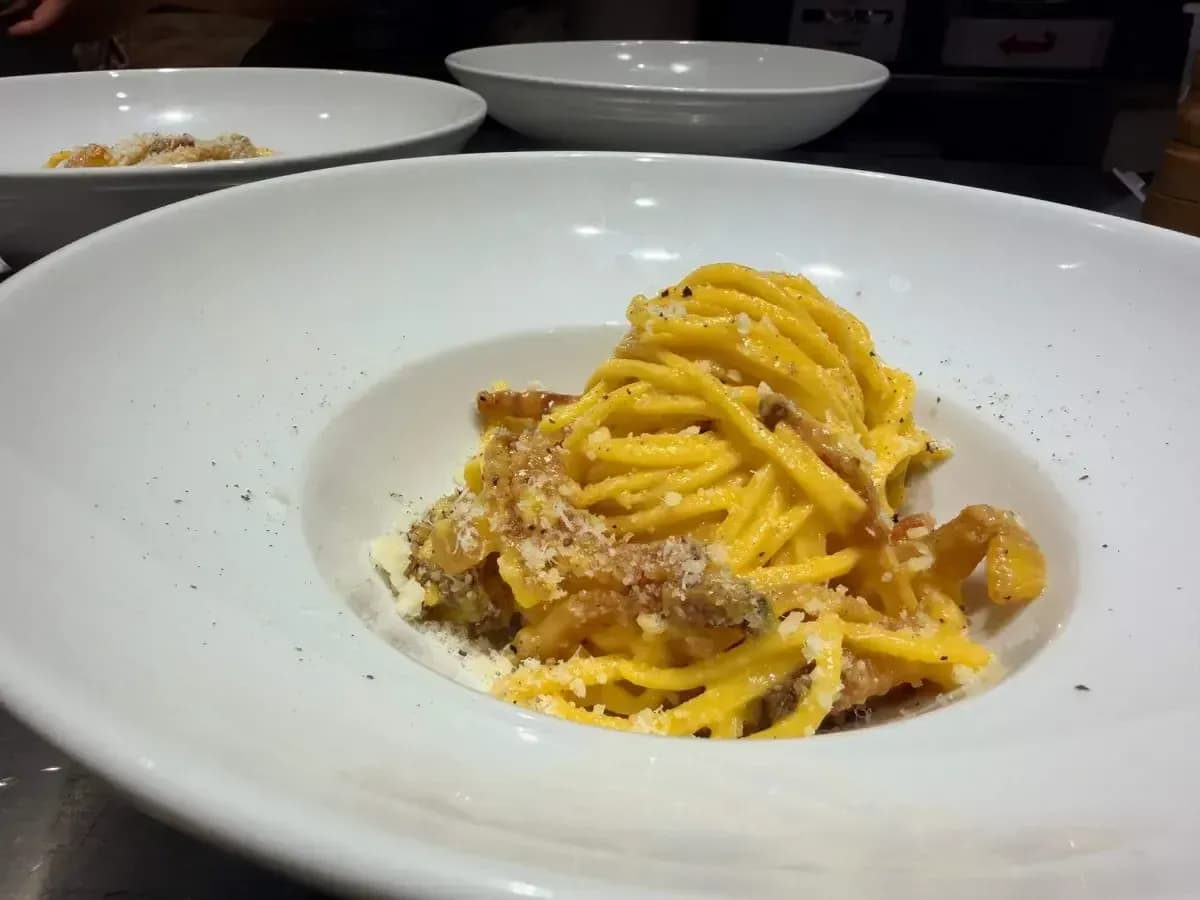
Four things: fresh egg pasta cut into tonnarelli, ricotta and spinach ravioli, amatriciana and tiramisù. The linked recipes are the ones we teach in this kitchen, so you can read them before the class or cook them again at home.
One dish needs a word. Amatriciana is built on guanciale, cured pork cheek. If you don't eat meat or pork, the amatriciana in this class is made without guanciale and becomes a tomato pasta. Just say so when you book. We call it what it is: without guanciale, it isn't amatriciana any more.
That is the one adaptation our dietary policy describes for this class, and we don't promise changes the policy doesn't describe.
What's on the menu in the pizza and gelato class?
Pizza margherita, the classic with tomato, mozzarella and basil, then pistachio gelato and hazelnut gelato. You knead the dough, stretch it and bake your own pizza, then make Italian gelato. Our pizza dough recipe is the round pizza stretched by hand in class, and the two flavours have their own recipes on the blog, pistachio gelato and hazelnut gelato, both made without an ice-cream machine.
It's the shorter of the two badge classes, two and a half hours. For a table where some eat meat and some don't, it's the menu nobody has to negotiate: everyone cooks the same thing.
What if you only have 90 minutes?
Then look at the gelato workshop. Its menu is gelato and nothing else: pistachio and hazelnut, with the base prepared from scratch and no machine, Italian wines and espresso included. It's hands-on: you prepare the base with a professional chef and learn the texture and flavour control you can repeat at home. It doesn't carry the Vegetarian friendly badge on its page. What we can tell you is its menu, and the menu is two flavours of gelato.
Both flavours are nuts. If you have a nut allergy, say so when you book.
Why isn't the Roman pasta class vegetarian?
Because of guanciale. The Roman pasta class teaches carbonara, amatriciana and cacio e pepe on fresh egg pasta, and its page carries a different badge: Meat Lovers. It lasts two and a half hours, with wines and Italian espresso included.
The carbonara cannot be made vegetarian or vegan, because guanciale is the heart of the dish. Take it out and you are cooking something else. Amatriciana without guanciale is just pasta al pomodoro, which is why this is the one class we don't offer without pork. Every other class can be made pork-free; this one can't, and we'd rather say it here than on the day.
The Spaghetti & Aperol Spritz class doesn't carry the vegetarian badge either: its menu includes spaghetti and meatballs.
Can a class be made vegan?
Vegan is a separate question from vegetarian. The carbonara can't be vegan, full stop. For every other class, a vegan adaptation needs the staff's approval before you book: not at the door, not in a note added after payment.
The pasta and tiramisù menu is not vegan as written: the pasta is fresh egg pasta, the ravioli are filled with ricotta, and the tiramisù is made with egg and mascarpone. So write to us from the contact page with the class you have in mind, wait for the answer, and book after that.
How do you tell us about allergies?
At booking. Tell us about any food allergies or dietary needs when you book, so we can prepare suitable ingredients. Whatever it is, eggs, dairy, nuts or anything else, it goes into the booking, not into a comment to the chef once the dough is already on the board.
The same goes for everyone in your party: if you're booking for others, ask each of them before you fill in the form.
Check the menus above against your allergies before you choose: there are eggs (fresh egg pasta, tiramisù), dairy (ricotta, mozzarella, mascarpone) and nuts (pistachio, hazelnut).
Can a vegetarian class be made gluten-free?
No. A class with gluten is never made gluten-free, not even for a single portion. Pasta and tiramisù and pizza and gelato are wheat classes, and they stay wheat classes.
Guests with coeliac disease book our dedicated gluten-free classes, gluten-free pasta and tiramisù or gluten-free pizza and gelato, both private, with dedicated tools and trained chefs: three hours for the pasta, two and a half for the pizza. In the group formats (families, kids, schools, universities, team building, companies and large groups), the whole group can choose one of the two gluten-free menus; for the largest groups it isn't guaranteed and is arranged with the staff. What doesn't exist is a single gluten-free plate in a shared class.
What else do vegetarians ask before booking?
Is "without pork" the same as vegetarian? No. Every class except the Roman one can be made without pork, but pork-free is not meat-free: the Spaghetti & Aperol Spritz menu still includes spaghetti and meatballs. For a vegetarian menu, start from the two classes with the badge.
What's included besides the cooking? In pasta and tiramisù, wines and Italian espresso. In pizza and gelato, wines, soft drinks and Italian espresso. In the gelato workshop, Italian wines and espresso.
Can we come as a family? For a session just for your family, book the private family class: a room reserved for you, all ages cooking at the same table, one menu picked at booking from our real classes, with fresh pasta, pizza or gelato made by hand. It lasts three hours, and wine is poured for the adults only. Dietary needs go into the booking, as for every class.
Where is the kitchen? At Piazza Margana 22, 2 minutes' walk from Piazza Venezia and the Altare della Patria, 5 from the Colosseum, 10 from Campo de' Fiori and the Pantheon. How to fit a class into a day of sightseeing is in our guide to a cooking class near the Colosseum and the Pantheon.
Which language are classes taught in, and when is private worth it?
Shared classes are taught in English. Private classes can also be taught in Italian or Spanish.
Go private when you want the kitchen to yourselves or a class in Italian or Spanish: both badge classes exist in a private version with the same menu. Everything we run, with each menu written out, is on the cooking classes page. If you don't eat meat, start from the two with the badge and read the menu before the title.

Written by
Francesco Ieriti
Founder of Italian Cooking Classes in Rome and head chef, with more than 14 years in international hospitality. He writes the recipes on this blog the way they are taught in class at Piazza Margana 22: per person, mistakes included.