Index
Index
Two booking pages can use almost the same words, "cooking class", "hands-on", "fresh pasta", and describe two very different afternoons. In one you roll the dough yourself at your own station; in the other you sit on a stool for two hours while a chef rolls it behind a counter, then eat a plate of it. The difference rarely makes it into the title.
Yet that's how most people pick from the best cooking classes in Rome: by title, by the first photo, by the slot that fits between the Colosseum and dinner. And that's how you end up watching instead of cooking. Choosing well takes about ten minutes of reading the right things, and we've written down what we'd read: the format, the menu, the clock, the dietary line, and the questions nobody thinks to ask until they're already standing in a kitchen with an apron on. We run one of these kitchens, at Piazza Margana 22, so take this for what it is: formats against formats, no names.
Hands-on or demonstration: what your hands actually do
In a hands-on class you get a bowl, flour and eggs, and the dough is yours. You knead it for ten minutes until it stops sticking, you rest it, you roll it, you cut it, you cook it, and if it's too wet the chef hands you more flour and makes you fix it.
In a demonstration the chef cooks and you taste. The stools are comfortable, the wine is poured, and you go home with the same hands you arrived with. Nothing wrong with a dinner show. It isn't a class.
The listing tells you which one it is, if you read the verbs. "Watch the chef prepare", "enjoy a tasting", "learn the secrets" are demo words. "Prepare the dough from scratch", "stretch", "bake your own" are cooking words. When the page says nothing about what you do with your hands, assume nothing, and ask.
One more test: does every person cook a full portion? Here a plate reaches the table only if the person making it finishes it. One bowl of dough between four people means three of them are watching.
How many of you there are, and what changes
A solo traveler and a party of ten are booking different things, even on the same menu.
Alone or as a couple, a shared class is the right call. Your dough is yours, the chef moves between the counters, and the table at the end is a table of strangers who've just spent two hours flouring each other. The spritz and spaghetti class is built for the evening, Aperol spritz poured alongside the work, and single seats are bookable.
Once you're a group rather than a couple, decide if you want the room to yourselves. In a shared session your party splits across the counters next to other guests. For a birthday, a bachelor party or a team that wants to talk shop over the pasta, a private booking closes the kitchen to the public for your slot. Everyone still cooks, nobody gets a back row.
At any size, ask if each guest has a station. It's the one detail that changes the whole experience.
The best cooking classes in Rome are chosen by menu, not by title
Titles are written for search engines. Menus are written for the kitchen. Read the menu.
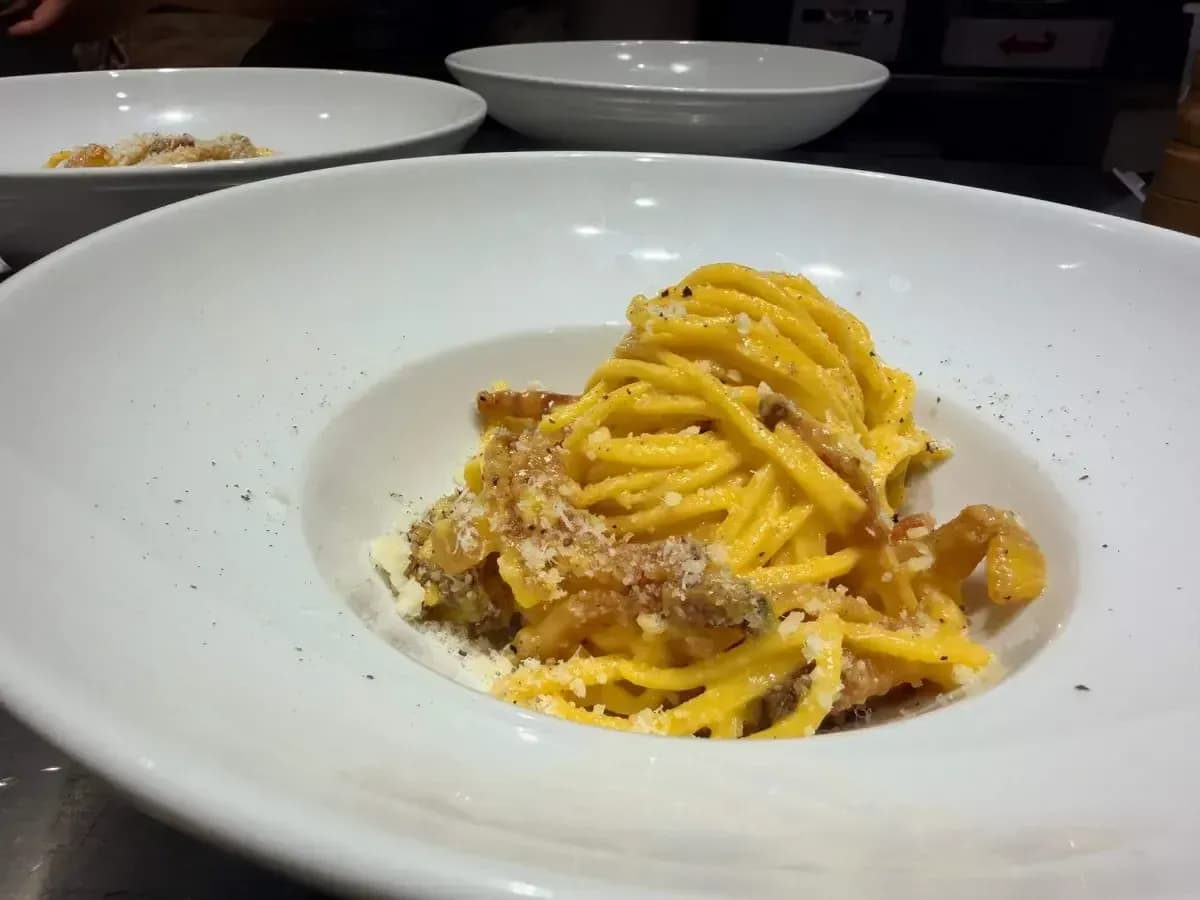
A "pasta class" can mean three different afternoons. Our carbonara workshop is two and a half hours on the three Roman sauces, carbonara, cacio e pepe and amatriciana, with the fresh pasta to carry them rolled by hand on the day. It's a meat-based menu, guanciale in the pan, the Roman classics as Rome cooks them.
Same flour, same eggs, a different day: the fresh pasta and tiramisu class is three hours, dough from scratch, shaping techniques, the classic tiramisu to close, and the menu is vegetarian friendly. The dough is our fresh pasta, the same as the tonnarelli.
No pasta at all in the pizza and gelato class, two and a half hours: you make the dough, stretch it by hand, top it, bake it, then make Italian gelato. Vegetarian friendly again, and the one children take to fastest, because stretching a disc of dough is a game before it's a technique.
Ninety minutes on the base alone is the gelato workshop: balancing the ingredients, building the structure, no special machines, pistachio and hazelnut on the sample menu.
And the market tour and cooking class is four hours, and the first part isn't in a kitchen: you walk a local market with the chef, choose seasonal ingredients, then come back and cook a complete menu with them.
Six shared formats, six different days, and the word "pasta" sits on three of the titles.
Duration and pace: 90, 150, 180 or 240 minutes
The length isn't padding. It follows the food.
Ninety minutes is a gelato base, and it fits between a museum and dinner. Two and a half hours is a full dish and a dessert, or three sauces and the pasta to go with them, and it doubles as lunch or dinner. People who book a class at five and a restaurant at eight are the ones pushing their plates away at the table.
Three hours is dough, shapes and a dessert: the pasta rests for half an hour before it will roll, and tiramisu has to set in the fridge while you eat. A pasta class promising dough to plate in ninety minutes is skipping the rest or bringing in sheets made earlier. Four hours is the market tour, because you shop before you cook, and choosing with a chef who explains why this bunch of chicory and not that one is half the lesson.
Every one of our classes ends at the table, eating what you cooked, with wine and Italian espresso included. That sit-down is part of the timing, not an extra, and it's where you find out if your carbonara held.
Celiac guests and allergies: a real answer versus a nod
Gluten is the question we get most, and the one where a vague answer should stop you booking.
We run two dedicated gluten-free classes, fresh pasta with tiramisu and pizza with gelato, both private. The gluten-free pasta is made by hand during the lesson, not brought in ready, with a separate workflow, dedicated tools and chefs trained for it. What we never do is add a gluten-free portion to a class cooked with wheat flour, shared or private, because a room full of hands in the flour can't promise a celiac guest anything. Groups work the other way round: in our group formats, for families, schools, companies and large groups, the whole group can choose one of the two gluten-free menus. For the largest groups that menu isn't guaranteed, and the event is arranged with the staff. If you need a certified environment, say so when you book and expect a straight answer about what a kitchen can and cannot guarantee. Anyone who says "no problem" without asking a single question hasn't understood the problem.
Vegetarians have an easier time. Pasta and tiramisu, pizza and gelato, both vegetarian friendly. The carbonara workshop is not, and shouldn't pretend to be: guanciale is the point of two of its three sauces.
Every other allergy: declare it at booking, not at the counter. A kitchen that finds out at the door improvises, and improvising is how mistakes happen.
Kids, families, companies and student groups
Children cook here, they don't watch their parents cook. Our family classes are private sessions where kids knead, shape and taste at the same table as the adults, and the pace is set for your group, which in practice means the youngest person at the table. Four menus can be booked this way; the aperitivo one is not among them, and the wine is poured for the adults only.
For a company, one menu for the whole group, kitchen closed to the public for your slot. Colleagues each have a station and cook a full portion, which is what makes it an activity rather than a spectator dinner.
School and university groups work the same way: one private room, one menu, teachers in the head count and cooking with the class. If the group is made up of minors, say so when booking so the table is set without wine.
Where the kitchen is and how you get there
Piazza Margana 22, 00186 Rome, in the historic center, a short walk from Piazza Venezia and within walking distance of the major landmarks. It's a small piazza, the kind you find by reading the street name on the corner, so give yourself five extra minutes the first time.
Location matters more than people think. A class on the far edge of the city costs an hour each way and turns a two-and-a-half-hour lunch into a five-hour errand.
When a private class makes sense
Every shared format we run also exists as a private class, same menu, same hands-on work, kitchen reserved for your group. The language can be Italian or Spanish on request; shared classes are always in English.
Book private when one of these is true: you have a celiac guest, because gluten-free is only ever private; you have children and want the room to move at their speed; you're celebrating and want your own table; or your group would otherwise be split between strangers. Book shared when it's two of you and you'd enjoy the company. The cooking is identical either way.
The questions to ask before you book
Send these to any kitchen before you pay, ours included. They tell you more than the photos.
- Do I cook or watch, and does every person get a station and finish a full portion?
- What is on the menu, dish by dish, and is the dough made from scratch during the class?
- How long is the session, and does that include sitting down to eat?
- Can you safely host a celiac guest, and what does that look like in practice?
- Which dishes are not vegetarian?
- What language is the class taught in?
- Where exactly is the kitchen?
- Is wine included, and what happens with children in the group?
- If we book private, what changes besides the room?
A kitchen that answers all nine without hesitating has thought about them. Book that one.
Choose the class you'd cook again at home
The right class is the one whose menu you'd repeat in your own kitchen next month. Three Roman sauces, book the carbonara. A Saturday of pizza with the kids, book the pizza and gelato. Ninety minutes to spare, make gelato and don't apologize for it.
The full list of what we run, shared and private, is on the cooking classes page. Read the menus and count the hours. What you cook is the meal, so come hungry.

Written by
Francesco Ieriti
Founder of Italian Cooking Classes in Rome and head chef, with more than 14 years in international hospitality. He writes the recipes on this blog the way they are taught in class at Piazza Margana 22: per person, mistakes included.