Index
Index
Every few weeks someone in the kitchen at Piazza Margana 22 asks, a little carefully, whether spaghetti and meatballs is real Italian food. The honest answer is no, and yes. Big meatballs sitting on a plate of pasta is not something you see on an Italian family table. The meatballs themselves, and the tomato sauce they cook in, are as Italian as anything we teach, and the emigrants who put the two on one plate in America were cooking from memory.
So this is our spaghetti and meatballs recipe as we make it in the Spritz and Spaghetti class: an American idea cooked with the proportions of an Italian home. Twenty small meatballs at about 30 g each, kept soft with stale bread soaked in milk. A sauce that starts on the crust the meatballs leave in the pan. And spaghetti tossed in that sauce before the meatballs go back on top. Sixty minutes from the bread bowl to the table, for four.
Ingredients for 4 people, and the numbers per person
Four people, one wide pan, one pot. Everything is counted per person too, so it scales without arithmetic.
- 240 g of beef mince, 60 g per person, with some fat in it
- 160 g of pork mince, 40 g per person
- 40 g of stale bread, 10 g per person, crust cut off
- 60 ml of whole milk, 15 ml per person, to soak the bread
- 30 g of grated parmigiano reggiano, a heaped tablespoon per person, plus more for the plates
- 1 whole egg for all four; it only binds
- 700 g of tomato passata, 175 g per person, plus 100 ml of water to rinse the bottle
- 1 clove of garlic, crushed, and a few basil leaves
- 4 tablespoons of extra virgin olive oil, two for browning, two for the sauce
- 360 g of spaghetti, 90 g per person
- Salt, black pepper, a tablespoon of chopped parsley, a pinch of nutmeg, and 40 g of salt for the 4 liters of pasta water
That comes to 20 meatballs of about 30 g, five per person. The meat is 100 g a head, which sounds like a lot until you remember this plate is the whole meal.
Why the bread goes into milk and not into the meat as breadcrumbs
The soft meatball is made in the first ten minutes. Day-old bread, crust off, torn into pieces the size of a hazelnut and left in 60 ml of whole milk until it drinks all of it and turns to paste between two fingers. Then squeezed hard, crumbled, and mixed in.
Soaked crumb holds water inside the meatball. That is what keeps it tender after 25 minutes in the sauce. Dry breadcrumbs do the opposite: they pull the meat's own juices into themselves and you get a firmer, closer texture, more like a rolled burger. Guests from the United States are often surprised by this, because breadcrumbs are what their grandmother used.
If breadcrumbs are all you have, use 30 g instead of 40 and soak them in the same 60 ml of milk for a few minutes first.
Beef and pork, sixty to forty, and one egg for the lot
Beef gives the flavor, pork gives the fat, and the fat is what melts inside the meatball while it sits in the sauce. All-beef meatballs look fine out of the pan and then eat dry.
Ask for beef that isn't extra lean, the kind sold as 80/20 or 85/15 outside Italy, and plain pork mince with nothing added. Sausage meat works in place of the pork, but it brings salt and fennel seed with it, so go lighter on the salt.
One egg for 400 g of meat is enough. People add a second one for safety and get a meatball that sets like a small omelette. The parmigiano, 30 g grated fine, seasons more than it binds, and here a tub of pre-grated cheese does no harm, because the meatball hides it. Swap one of the four spoons for pecorino romano if you want a sharper meatball.
An American plate with Italian parents
In an Italian home, polpette al sugo are a second course. They come to the table on their own, with bread for the sauce, and whatever sauce is left dresses the pasta the next day. The two arriving on one plate, big meatballs on top, is what emigrants from central and southern Italy built in the United States in the early twentieth century. Meat had suddenly become affordable, canned tomatoes and dry pasta were cheap, and a poor dish grew into a rich one.
Gambero Rosso has a good account of this, and one detail matters here: the meatballs in those early versions were far smaller than what a Little Italy restaurant serves now, closer to the pallottine of Abruzzo, the one corner of Italy where spaghetti alla chitarra does get dressed with tiny meatballs. So when we keep ours at 30 g, we aren't correcting the American plate. We're cooking it the way it started.
Italians who see it on a menu abroad assume it's a tourist invention. It has roots. They just run through Ellis Island rather than Naples.
Why 30 grams is the right size for a meatball in sauce
A meatball the size of a walnut in its shell browns in five or six minutes and finishes in the sauce in twenty to twenty-five, no dry ring outside, no pink at the center. At the size of a tennis ball, which is what guests who grew up with the American version reach for, the outside is overcooked long before the middle is done, and the only fix is more time, which makes the outside worse.
If you want them bigger anyway, 60 g is the ceiling, with ten more minutes in the sauce and no more.
How to make this spaghetti and meatballs recipe step by step
Thirty minutes with your hands, thirty with the pan, and the pasta water goes on when the meatballs go back into the sauce.
Bread into the milk before anything else, because it needs ten minutes and the rest takes two. Once it's squeezed and crumbled, everything lands in one wide bowl: the two minces, the parmigiano, the egg, the parsley, the nutmeg, a pinch of salt, some pepper. Fingertips, not fists. When the streaks of bread and cheese have gone, you're done, even if the bowl looks untidy.
Wet hands, and the scale used exactly once: weigh the first meatball at 30 g, look at it, and roll the other nineteen to match. A cracked surface now is a split meatball later.
Browning is the part guests rush. Two tablespoons of oil in a wide pan over lively heat, meatballs in with space between them, two batches if needed. For the first minute nothing happens except the crust forming, and that minute is left alone. After that the pan gets moved, not the meatballs. Five to six minutes in all, brown on every side and still soft when pressed, then out onto a plate. The dark bits stuck to the bottom stay.
Those bits are the sauce. Heat down, two more tablespoons of oil, the crushed garlic for 30 seconds without taking color, then 700 g of passata and the 100 ml of water you swirled around the bottle. A wooden spoon across the bottom lifts the crust into the tomato. Basil, a pinch of salt, meatballs back in, half covered.
Then 20 to 25 minutes of almost nothing: lid ajar, a bubble every second or two, a gentle turn once or twice. The red goes dull and brick-colored, oil shows at the edges, and the sauce holds a line for a moment when you drag a spoon through it. Taste for salt only now.
Spaghetti, 360 g in 4 liters of water with 40 g of salt, out a minute before the packet says. Meatballs aside for a moment, pasta into the sauce with a spoonful of its water, a full minute of tossing over medium heat until nothing pools under the strands. Warm plates, five meatballs on each, the last of the sauce spooned over, parmigiano on top.
The mistakes we see at the meatball station
Kneading. Every class, without fail, someone treats the bowl like pizza dough and works it for five minutes. The meatballs come out tight and gray and bounce under the fork. Once the mince has tightened there's no way back; the cure is stopping earlier next time.
The spoon. A freshly shaped meatball tears the moment a spoon goes under it, and the tear is where it falls apart in the sauce. The pan rolls them; the spoon is for taking them out. A cousin of this mistake is a pan that isn't hot enough, so the first meatball lands without a hiss and welds itself to the bottom.
A hard boil under the sauce. Twenty minutes of rolling boil turns passata sour and scorches whatever sits on the bottom. If you can hear the sauce from across the kitchen it's too hot.
Sugar. If the tomato tastes sharp, it needs a pinch of salt and five more minutes, not a spoon of sugar. Sugar in a tomato sauce is a confession, not a fix.
Naked spaghetti with a ladle on top. This is how most restaurants abroad serve it, and it's why the pasta tastes of nothing while the sauce slides to the bottom. One minute in the pan does more for this dish than any other move here.
Making it ahead, and the fresh spaghetti question
The meatballs and the sauce are better the next day. Cool the pan, keep everything together in the fridge for up to two days, and reheat gently with a splash of water. They freeze well in their sauce too. What you never do ahead is the spaghetti: that goes in the water when people are sitting down.
In class we make the spaghetti fresh, from flour and eggs. The recipe above is written for dry spaghetti because that's what most kitchens have and what the original plate was made with. If you want to roll your own, the dough and the cutting are in our fresh egg pasta guide; fresh strands are done in two or three minutes, and they still want their minute in the sauce.
The other dish in that session is spaghetti alla Nerano, fried zucchini and provolone from the Sorrento peninsula: one long simmer, one fast toss, the same fresh spaghetti under both.
Where to learn spaghetti and meatballs in Rome
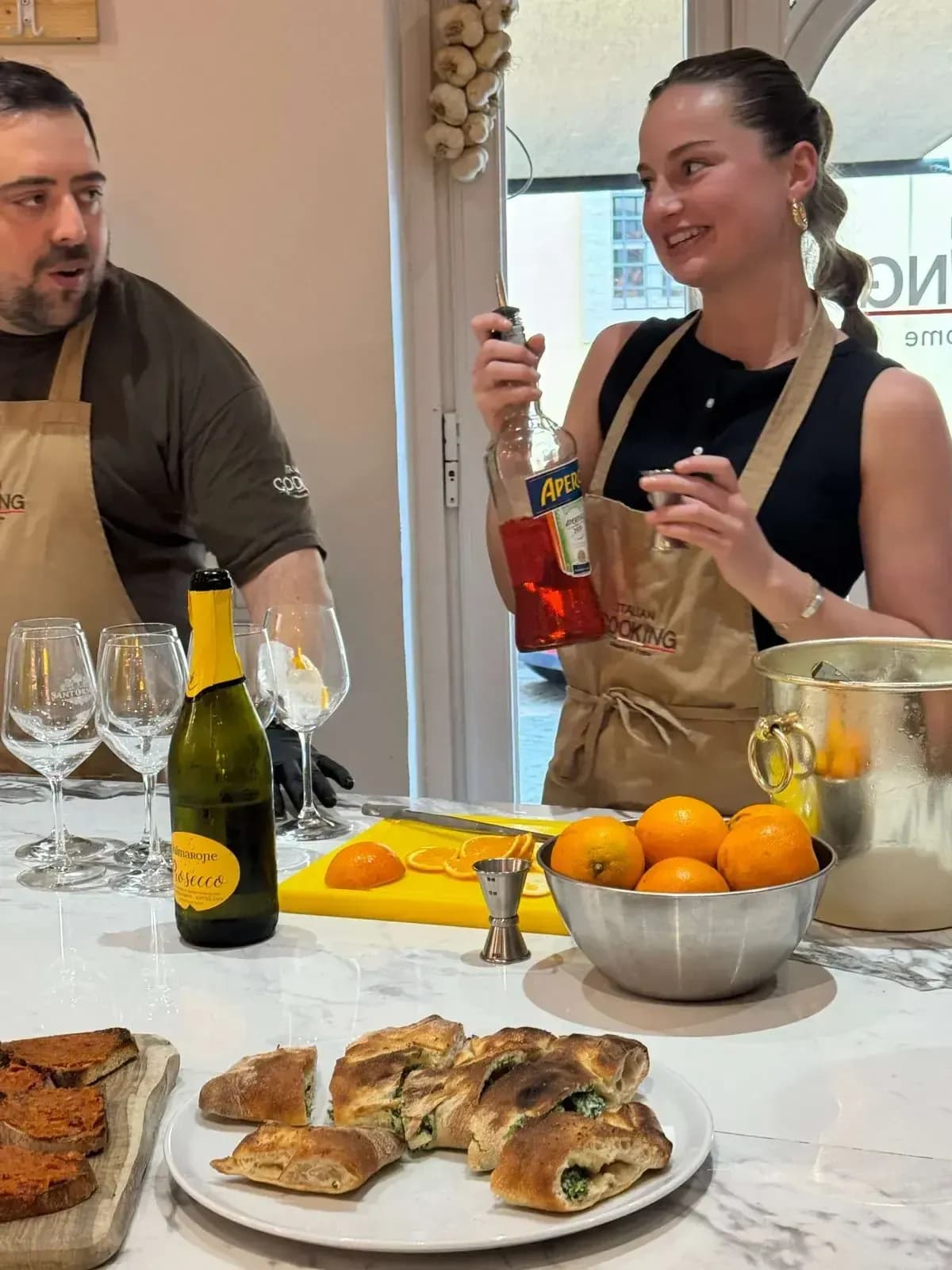
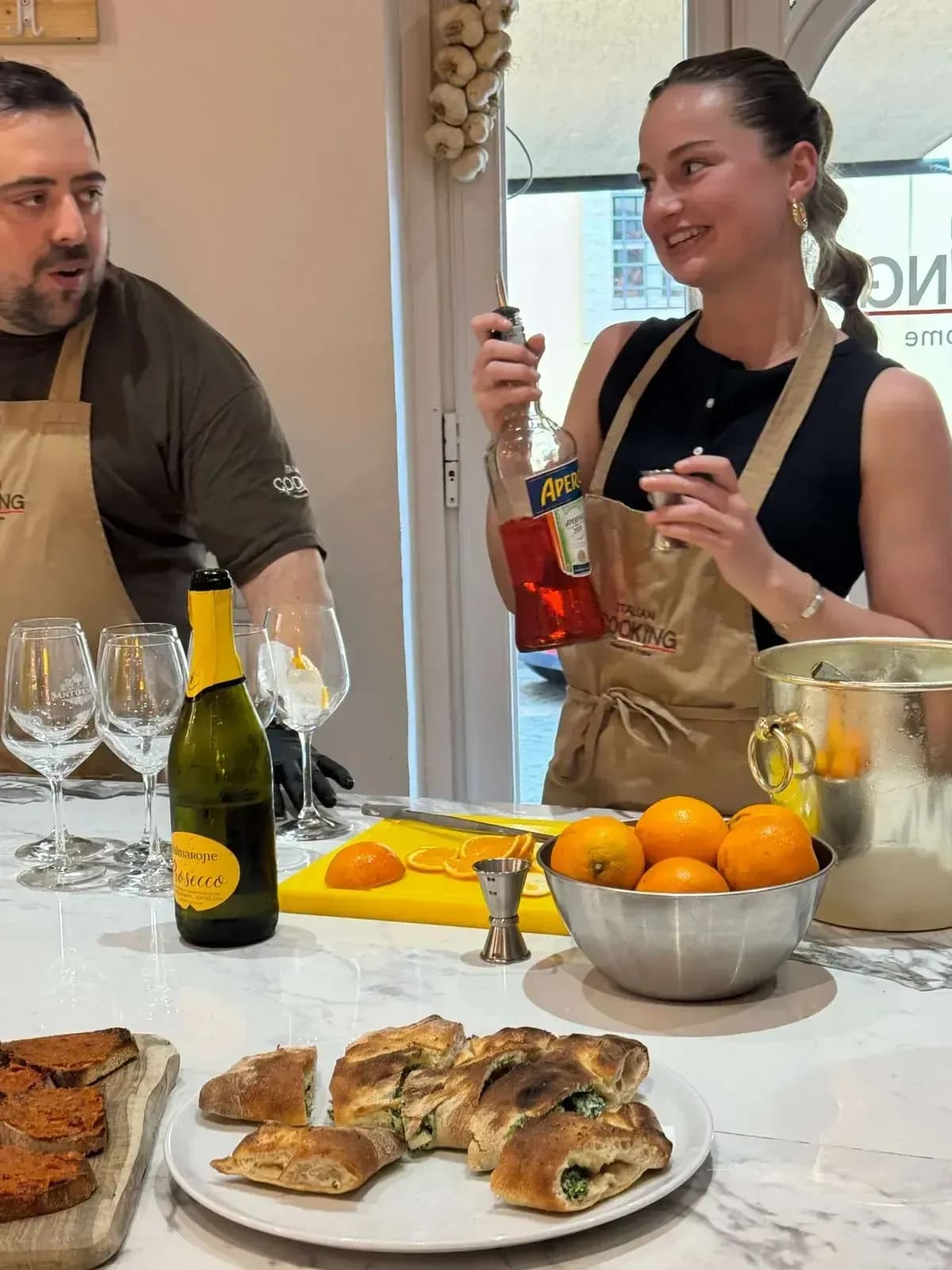
In our kitchen at Piazza Margana 22, in the center of Rome. The Spritz and Spaghetti class runs for about two and a half hours: you make fresh spaghetti from scratch and cook two recipes with the chef, this one and the Nerano, with Aperol spritz and Italian wine poured while you work. At the end everyone sits down at the shared table to eat what they cooked, with an espresso to close.
Groups who want the room to themselves can book the private version of the same class. Everything else we run is on the cooking classes page.
Skip lunch that day. Five meatballs and 90 g of spaghetti a head is a full dinner, not a tasting.
Recipe details
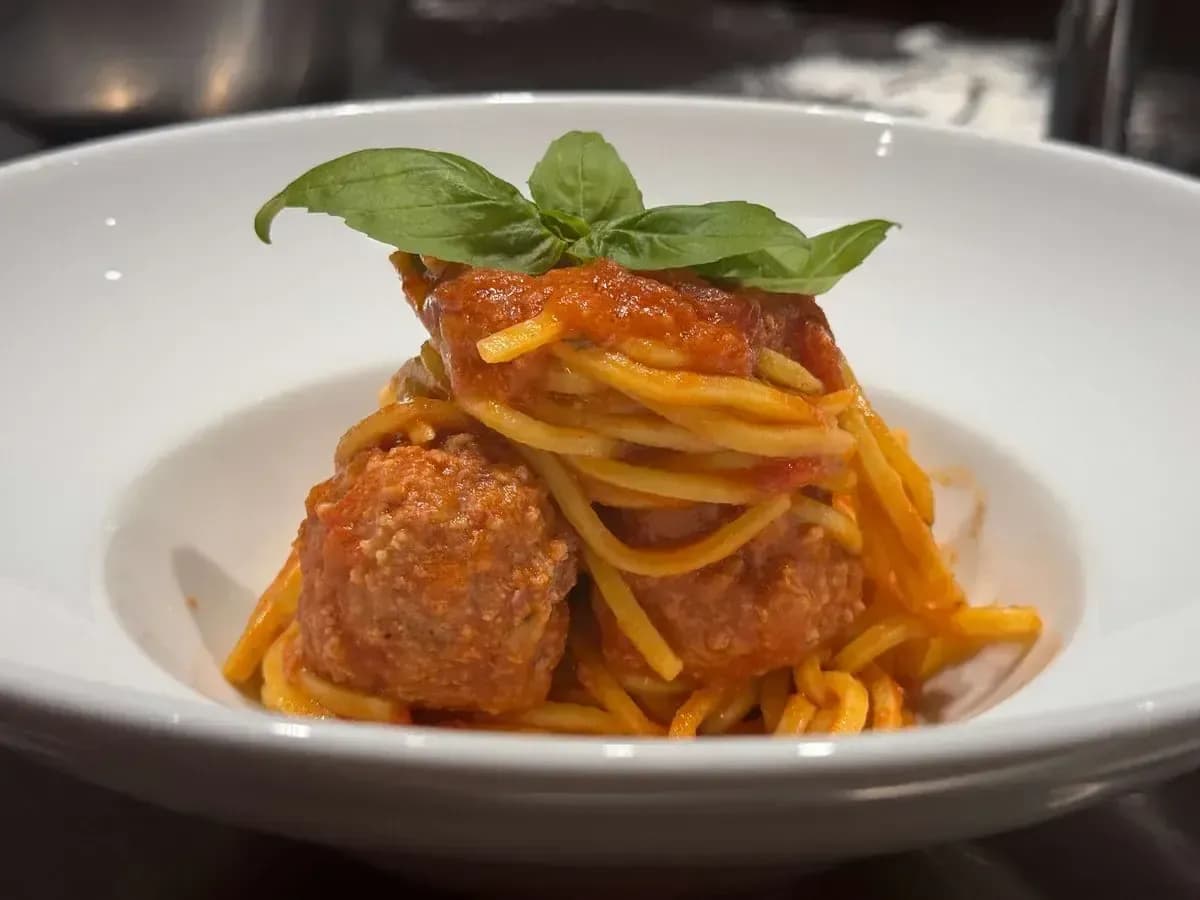
Spaghetti with meatballs in tomato sauce, the way we cook it in the Spritz and Spaghetti class at Piazza Margana 22. We say it plainly: pasta and meatballs on the same plate was born among Italian emigrants in America, but the meatballs and the sugo are what Italian families have made for generations. Beef and pork, stale bread soaked in milk, parmigiano, one egg, tomato passata. The rule is size: about 30 g each, browned first, then finished in the sauce.
Preparation
Soak the bread in milk
Cut the crust off 40 g of stale bread, tear the crumb into pieces the size of a hazelnut and drop it into a bowl with 60 ml of whole milk. Leave it for 10 minutes: it is ready when it has drunk all the milk and turns to paste between two fingers. Squeeze it firmly in your fist so no milk runs out, then crumble it. Soaked bread, not dry breadcrumbs, is what keeps the meatballs soft after 25 minutes in the sauce.
Mix the meatball base without overworking it
In a wide bowl, combine 240 g of beef mince and 160 g of pork mince with the squeezed bread, 30 g of grated parmigiano, 1 whole egg, a tablespoon of chopped parsley, a pinch of nutmeg, a pinch of salt and some pepper. Work it with your fingertips for about 2 minutes, just until you no longer see streaks of bread or cheese. Stop there: the mix should still look loose and rough. If you knead it like dough it tightens and the meatballs come out dense.
Shape 20 meatballs of about 30 g
Wet your hands in cold water, take about 30 g of mix (weigh the first one, the rest by eye) and roll it between your palms with light pressure until the surface is smooth and closed. You should get 20 meatballs, 5 per person, each about the size of a walnut in its shell. Line them up on a plate as you go and wet your hands again whenever the mix starts to stick.
Brown the meatballs on all sides
Heat 2 tablespoons of extra virgin olive oil in a wide pan over lively heat and lay the meatballs in without crowding them, in two batches if needed. Leave them alone for a good minute so a crust forms, then rotate the pan by its handle rather than poking them with a spoon: 5 to 6 minutes in all, until they are brown on every side but still soft when pressed. Lift them onto a plate. The brown bits stuck to the bottom stay: they are the base of the sauce.
Build the sauce in the same pan
Lower the heat, add 2 more tablespoons of oil and a crushed clove of garlic, and let it sizzle for 30 seconds without colouring. Pour in 700 g of tomato passata, rinse the bottle with 100 ml of water and add that too, scraping the bottom with a wooden spoon so the crust from the meatballs dissolves into the tomato. Add a few basil leaves and a pinch of salt, and bring it to a gentle bubble.
Simmer the meatballs in the sauce for 20 to 25 minutes
Return the meatballs to the pan with any juices from the plate, spooning sauce over them so they are half covered. Lid ajar, heat low enough that you see a bubble every second or two, not a boil. Turn them gently once or twice in 20 to 25 minutes. The sauce is done when it has darkened from bright red to brick red, the oil shows in small pools at the edges and a spoon dragged through the pan leaves a trail that closes slowly. Taste for salt now, not before.
Cook the spaghetti and bring it together
Boil 4 litres of water with 40 g of salt and cook 360 g of spaghetti, draining them 1 minute before the time on the packet. Lift the meatballs out of the pan for a moment, tip the spaghetti into the sauce with a spoonful of pasta water and toss over medium heat for a full minute, until the sauce clings to the strands instead of pooling underneath. Divide between warm plates, set 5 meatballs on each, spoon over the sauce left in the pan and finish with grated parmigiano.
What goes wrong at the meatball station
The first thing we see, every single class, is the mix being kneaded. Someone squeezes and folds it for five minutes as if it were pizza dough, and the meatballs come out tight and grey, and they bounce under the fork. Mince only needs two minutes with the fingertips, until the bread and cheese disappear into it. If it still looks a bit rough and open, that is right.
The second is size. Guests who grew up with the American version want a meatball the size of a tennis ball, and then the outside is overcooked before the middle is done. At 30 g the meatball browns in six minutes and finishes in the sauce in twenty, with no dry core. If you do want them bigger, go to 60 g and give them ten minutes more in the sauce, no more than that.
The third is the spoon. Freshly shaped meatballs are fragile, and the way to turn them without breaking them is to hold the pan by the handle and roll them around, with the spoon only used to take them out. Related to this: a pan that is too cold. If the oil does not hiss when the first meatball goes in, wait. Without a crust they stick, and when they stick they tear.
The last one is heat under the sauce. Passata boiled hard for twenty minutes turns sour and the meatballs on the bottom scorch. The surface should barely move, one bubble at a time, with the lid resting on the handle so the steam has a way out.
Bread, mince and passata: what to buy outside Italy
The bread matters more than people expect. We use the crumb of day-old bread soaked in milk, because it holds water and keeps the meatballs tender after a long time in the sauce. Dry breadcrumbs are a different ingredient: they absorb the meat's own juices and the result is firmer. If breadcrumbs are all you have, use 30 g instead of 40 and soak them in the same 60 ml of milk for a few minutes before mixing.
On the meat, ask for beef with some fat in it, the kind sold as 80/20 or 85/15 rather than extra lean, and plain pork mince without added seasoning. Sausage meat works, and Giallo Zafferano's recipe uses it, but it usually brings salt and fennel with it, so hold back on the salt in the mix. Do not go all beef: pork is what keeps the meatball soft and juicy.
The cheese is parmigiano reggiano, grated fine. Pecorino romano is a fine addition, one spoon in place of one of the four, if you want a sharper meatball. A tub of pre-grated cheese is fine here, unlike in a carbonara, because the meatball hides it.
For the sauce, a bottle of passata di pomodoro is the closest thing to what we pour in class: smooth, uncooked, no herbs, no sugar. Crushed tomatoes in a can are the next best thing. Marinara sauce from a jar is already cooked, already seasoned, and after 25 minutes with the meatballs it will taste heavy and sweet. And no sugar in the sauce, ever: if the tomato is sour, it needs a pinch of salt and five more minutes, not sugar.
An American plate with Italian parents
In Italy you will not find spaghetti and meatballs on a family table. Meatballs in tomato sauce are a second course, served with bread to mop the plate, and the sauce they cooked in might dress the pasta the day after. The pairing on a single plate, with big meatballs sitting on top of the spaghetti, was created by emigrants from central and southern Italy in the United States in the early twentieth century. Meat was suddenly affordable, canned tomatoes and dry pasta were cheap, and a poor dish became a rich one. Gambero Rosso has a good account of it, and points out that the meatballs of the early versions were far smaller than what Little Italy restaurants serve today, closer to the pallottine of Abruzzo, where spaghetti alla chitarra is traditionally dressed with tiny meatballs.
That is why the plate we teach has small meatballs and a light hand with the sauce: it is the Italian-American idea cooked with the proportions of an Italian home kitchen. The spaghetti are tossed in the sugo first, the meatballs go on top, the parmigiano goes on last.
We cook it in the Spritz and Spaghetti class, two and a half hours in the kitchen at Piazza Margana 22, which opens with a spritz and pairs this dish with spaghetti alla Nerano, the Sorrento peninsula pasta with fried courgettes and provolone. The full list is on the cooking classes page.
Ingredients
240 g of beef mince, 60 g per person, not too lean
160 g of pork mince, 40 g per person
40 g of stale bread, 10 g per person, crust removed
60 ml of whole milk, 15 ml per person, to soak the bread
30 g of grated parmigiano reggiano, 7.5 g per person (a heaped tablespoon), plus more for the plates
1 whole egg, a quarter per person, it only binds
700 g of tomato passata, 175 g per person, plus 100 ml of water to rinse the bottle
1 clove of garlic, crushed, and a few basil leaves
4 tablespoons of extra virgin olive oil, one per person: two for browning, two for the sauce
360 g of spaghetti, 90 g per person
Salt: a pinch in the mix, 10 g per litre in the pasta water (4 litres, 40 g); black pepper, a spoon of chopped parsley, a pinch of nutmeg
Method
- 1
Bread first, then meat. Tear 40 g of crustless stale bread into a bowl with 60 ml of milk and leave it ten minutes, until it falls apart when you press it. Squeeze it and crumble it into 240 g of beef mince and 160 g of pork mince with 30 g of grated parmigiano, one egg, a spoon of chopped parsley, a pinch of nutmeg, salt and pepper. Work it with your hands for two minutes and stop: overworked mince turns rubbery.
- 2
Twenty meatballs, about 30 g each. Wet your hands, weigh the first one, then keep going by eye. Five per person, the size of a walnut in its shell. They are smaller than the ones served in a Little Italy restaurant, and they cook through in the sauce without a dry centre.
- 3
Brown them in two spoons of oil over lively heat, five or six minutes, moving the pan rather than the meatballs so they keep their shape. Lift them out. In the same pan, on the crust they left behind, warm two more spoons of oil with a crushed clove of garlic, pour in 700 g of passata and 100 ml of water, add a few basil leaves and a little salt.
- 4
The meatballs go back in and the sauce does the rest. Twenty to twenty-five minutes at a low simmer with the lid ajar, a gentle turn every so often. It is ready when the colour has gone from bright red to brick and the sauce coats the back of a spoon.
- 5
Spaghetti, 360 g, drained a minute early into the sauce, with the meatballs set aside for a moment so they do not break up. A spoon of pasta water, a minute of tossing, parmigiano, then the meatballs back on top of each plate.

Written by
Francesco Ieriti
Founder of Italian Cooking Classes in Rome and head chef, with more than 14 years in international hospitality. He writes the recipes on this blog the way they are taught in class at Piazza Margana 22: per person, mistakes included.